
Prospect Hill Tin Project
South Australia
The Prospect Hill project covers a total area of 75 km2. The western portion features outcropping rocks of the Curnamona Craton (Mt Babbage Inlier – Figure 1) which hosts widespread polymetallic mineralisation, predominantly tin (Sn) with minor base metals (Cu-Zn-Pb). Tin is present as cassiterite and this will be the initial focus of HRE’s non-uranium exploration and development activities at Prospect Hill.

Figure 1: Regional geology of Palaeo-Mesoproterozoic Mt Painter and Mt Babbage Inliers
The project area has seen a number of relatively short-lived exploration campaigns for tin and other metals since the mid-1980s, at times when tin prices were substantially lower than today. This work resulted in the discovery of several high-grade tin prospects at surface, including the South Ridge prospect where 56 drillholes outlined tin-rich mineralisation in a well-defined lode structure over a strike length of about 500m (Figure 2). Highly mineralised drill intercepts from South Ridge include:
- 3 m @ 4.85% Sn from 44 m in PHRC03
- 5 m @ 3.32% Sn from 84 m in PHRC55
- 6 m @ 2.33% Sn from 14 m in PHP-15
- 6 m @ 1.85% Sn from 24 m in PHP-2
- 8 m @ 1.48% Sn from 11 m in PHRC24
- 10 m @ 1.16% Sn from 33 m in PHRC04

Figure 2. Plan view of South Ridge prospect with selected drill and trench intersections
HRE plans to fast-track follow-up drilling at South Ridge in the coming months with the aim of achieving a maiden JORC Mineral Resource and to acquire material for metallurgical testwork. Limited, historical testing, focused on producing a concentrate by gravity separation but application of the latest, sensor-based, ore sorting technology on cassiterite concentrates, such as that offered by Germany’s TOMRA Mining, could represent a substantial opportunity for HRE at South Ridge.
The acquisition of non-uranium mineral rights at Prospect Hill broadens HRE’s exposure to strategic critical minerals, essential for the clean energy transition.
Tin is used in a wide variety of products including solder (electronics), chemicals (PVC stabilizers, polymer catalysts), alloys (bearing metal, coatings), inorganic (ceramics, glazes) and organic (plastics, wood preservatives, fire retardants) compounds. Tin futures are currently holding close to the three month high of US$35,100 as persistently low supply coincides with evidence of robust demand.
Investment in new tin supply has been relatively weak for some time, with only one significant mine entering the market in the last five years. According to the International Tin Association, looming tin deficits and geopolitical concerns will drive the search for new projects and the coming decade will see a new wave of government-supported investment to secure sustainably sourced supply that needs to grow by an estimated 50,000 tonnes per annum for the technology surge to 2030.
REGIONAL GEOLOGY
The Prospect Hill project lies in the Mt Babbage Inlier at the north-western margin of the Palaeo-Mesoproterozoic Curnamona Craton, a geological province well-endowed in critical and clean energy minerals such as copper (Cu), uranium (U), and REEs, associated with a widespread igneous intrusion event dating from around 1590 Ma (Figure 2).
LOCAL GEOLOGY AND MINERALISATION
In the project area, the Mt Babbage Inlier is dominated by Palaeoproterozoic volcanics and volcaniclastics which have been intruded by multiple, younger, Mesoproterozoic, granitoids (Figure 3). Unlike the older igneous event, these younger granites (1560 Ma) are anomalous in Sn as well as other critical minerals – copper (Cu), fluorine (F), tungsten (W), uranium (U), molybdenum (Mo) and rare earths (REEs). Intrusion of the younger granites are interpreted to be responsible for the tin-rich polymetallic mineralisation. Multiple styles of tin (Sn) mineralisation have been recognised, including:
i) Epigenetic fault/shear mineralisation associated with anomalous F, U, yttrium (Y), zinc (Zn) and Cu. This is the most significant style at Prospect Hill, seen at the South Ridge prospect
ii) A silica-muscovite-tourmaline association, expressed at surface in elliptical or pod-like accumulations. The 3D dimensional shape is unknown at this stage but they may represent shoots or “pipes”. Although limited in surface extent, these represent significant targets due to their high-grade nature (e.g., up to 56% Sn at the Black Rock prospect); and
iii) HRE considers the Prospect Hill Block to be a unique, highly prospective terrain in which to discover Sn-rich deposits.
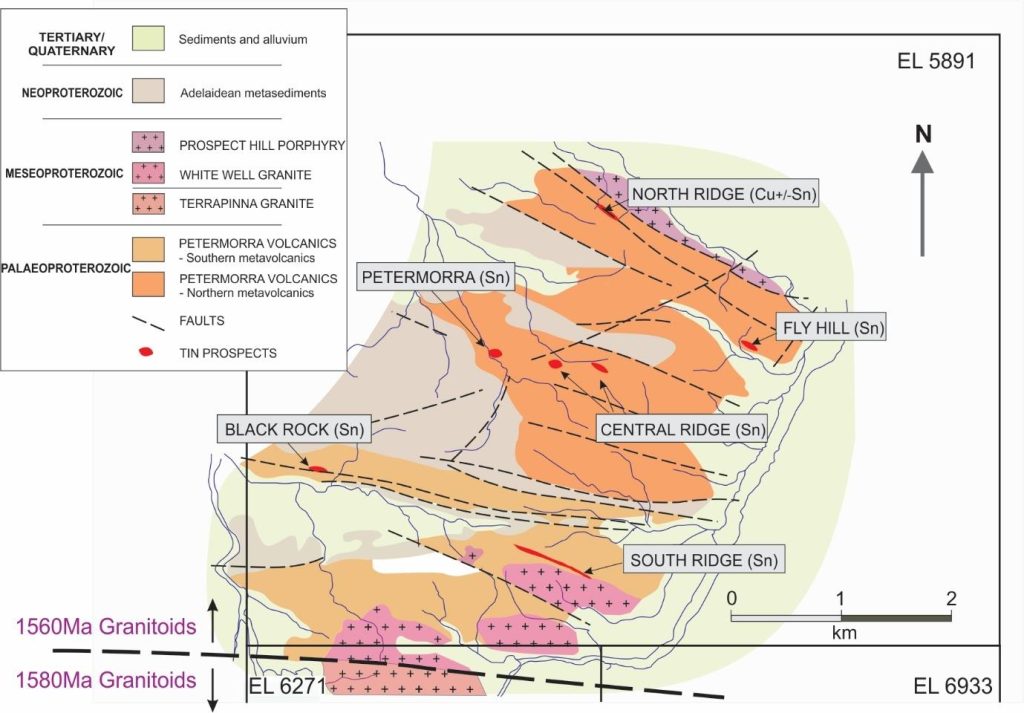
Figure 3: Summary of outcropping geology in EL5891 and location of Sn prospects